Sign In










 Facebook
 X-Twitter
 Instagram
 Linkedin
 Youtube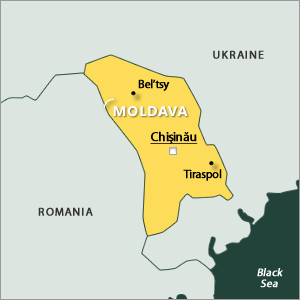

Significance
Immigration from Moldova has generally reflected the legacy of the Soviet Union, political transition, economic opportunity, educational advancement, professional employment, family reunification, skilled migration, and international business.
Migration from Moldova has historically been shaped by political transformation, economic restructuring, and its location in Eastern Europe. Before independence, migration primarily occurred within the Soviet Union for education, industrial development, agriculture, military service, and government assignments. Following the dissolution of the Soviet Union in 1991, many Moldovans sought opportunities abroad because of economic reforms, limited employment, and expanding global educational and professional opportunities. The United States became a destination for students, healthcare professionals, engineers, researchers, entrepreneurs, and skilled workers through higher education, employment, family sponsorship, and business investment. Today, Moldovan immigrants maintain strong cultural, linguistic, and family ties with their homeland while contributing to diverse sectors of the American economy.
Moldovan Migration Before Independence
Before independence, most of present-day Moldova formed part of the Russian Empire before becoming the Moldavian Soviet Socialist Republic, one of the republics of the Soviet Union. Migration during the Soviet era was influenced by industrialization, agriculture, scientific research, military service, higher education, and government administration. Residents frequently relocated throughout the Soviet Union as farmers, engineers, teachers, healthcare workers, scientists, students, military personnel, and civil servants. Direct migration to the United States remained relatively uncommon because international travel was tightly regulated and political, educational, and economic connections were concentrated within the Soviet bloc. Moldova declared independence on August 27, 1991, following the dissolution of the Soviet Union, and the United States recognized the new nation later that year before establishing diplomatic relations.
Late-Twentieth- and Early-Twenty-First-Century Immigration
Migration increased after independence as economic reforms, globalization, and expanding educational opportunities encouraged many Moldovans to pursue careers abroad. Students, physicians, engineers, scientists, academics, entrepreneurs, information technology specialists, business professionals, and researchers increasingly travelled to the United States for university education, specialized employment, scientific collaboration, investment, or family reunification. Academic exchange programs, multinational companies, and professional recruitment have continued to strengthen migration in recent decades, while family sponsorship has supported the growth of Moldovan communities across the United States. In the United States, Moldovan immigrants often rely on family networks, churches, cultural associations, alumni organizations, and professional groups for support with housing, employment, education, and community integration while preserving Romanian, Russian, Gagauz, traditional cuisine, cultural heritage, religious practices, and close relationships with relatives in Moldova