Sign In










 Facebook
 X-Twitter
 Instagram
 Linkedin
 Youtube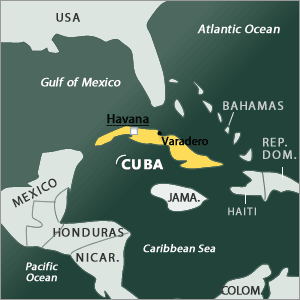

Significance
Cuban immigration to the United States has generally reflected geographic proximity, political exile, cigar-industry employment, revolution, communist rule, economic hardship, refugee policies, family reunification, and the search for greater freedom and opportunity.
Cuban migration to the United States began well before the twentieth century because the two countries were connected through trade, shipping, politics, and the narrow Florida Straits. During the nineteenth century, cigar manufacturers and workers established communities in Key West, Tampa, New York, and New Orleans, while Cuban independence activists used American cities as centres for organising and publishing. Migration changed dramatically after the 1959 Cuban Revolution, when political opponents, professionals, business owners, workers, and families began leaving the island in large numbers. Later waves arrived through the Freedom Flights, the 1980 Mariel boatlift, the 1994 rafter crisis, family-sponsored immigration, and humanitarian programmes. South Florida, particularly Miami, became the principal centre of Cuban American community life.
Cuban Migration Before the Revolution
Before the Cuban Revolution, migration was shaped by Spanish colonial rule, independence movements, maritime commerce, political exile, and the tobacco industry. After social and political unrest intensified in Cuba during the nineteenth century, cigar manufacturers relocated operations to Key West and later Tampa, attracting thousands of Cuban workers and their families. Immigrants established neighbourhoods, mutual-aid societies, newspapers, labour organisations, theatres, and businesses. Political leaders such as José Martí also worked among Cuban communities in the United States while organising support for independence from Spain. Following the Spanish-American War, Spain relinquished control of Cuba, and the Republic of Cuba was established in 1902. Migration across the Florida Straits remained frequent, with many workers travelling repeatedly between Havana, Tampa, and Key West according to employment opportunities.
Post-Revolutionary Immigration
Cuban immigration increased dramatically after Fidel Castro’s revolutionary government took power in 1959. Early exiles included former officials, professionals, business owners, landowners, and families opposed to the new government. More than 200,000 Cubans had reached the United States by 1962, and approximately 300,000 arrived through the Freedom Flights between 1965 and 1973. The Cuban Adjustment Act of 1966 created a special pathway through which eligible Cuban arrivals could obtain permanent residence. Further migration occurred during the Mariel boatlift of 1980 and the balsero, or rafter, crisis of 1994. New arrivals often faced language barriers, interrupted careers, family separation, and financial hardship. Cuban Americans nevertheless created influential businesses, churches, media organisations, cultural institutions, and political networks while preserving Spanish, music, food, religious traditions, and close connections with Cuba.