Sign In











 Facebook
 X-Twitter
 Instagram
 Linkedin
 Youtube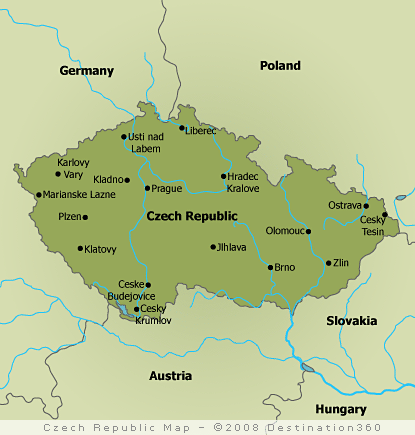

Significance
Czech immigration to the United States has generally reflected agricultural hardship, industrial change, political repression, war, communist rule, education, professional employment, religious freedom, and family reunification.
Czech migration to the United States became significant during the nineteenth century, particularly after restrictions on emigration from the Habsburg territories were reduced during the 1860s. Early arrivals came mainly from Bohemia, Moravia, and Czech Silesia and were often officially recorded as Bohemians, Austrians, or later Czechoslovaks. Farmers, artisans, miners, factory workers, merchants, and political activists settled in Chicago, Cleveland, New York, Wisconsin, Iowa, Nebraska, Texas, and other regions. Czech immigrants established farming communities, neighbourhoods, newspapers, schools, churches, freethinking societies, theatres, fraternal organisations, and cultural institutions. These organisations helped newcomers find employment and housing while preserving Czech language, music, food, literature, and national identity.
Czech Migration Before Czechoslovak Independence
Before an independent Czechoslovakia was established, the Czech lands formed part of the Habsburg monarchy and later Austria-Hungary. Political restrictions, the decline of traditional peasant farming, population growth, limited land, and industrial employment opportunities encouraged migration during the nineteenth and early twentieth centuries. Czech settlers worked in agriculture, meatpacking, manufacturing, mining, construction, skilled trades, and small businesses. Large communities developed in Chicago, Omaha, Cleveland, New York, and rural areas of Nebraska, Iowa, Wisconsin, and Texas. Immigrants created organisations such as mutual-aid lodges, gymnastic societies, newspapers, schools, and community halls. After World War I, Czechoslovakia emerged from the dissolution of Austria-Hungary, and the United States recognised its national council as a de facto government in 1918.
Twentieth-Century Immigration
Czech immigration continued during the twentieth century as Nazi occupation, World War II, the communist takeover of Czechoslovakia in 1948, and the Soviet-led invasion of 1968 drove refugees, political opponents, intellectuals, artists, academics, and professionals abroad. Communist authorities restricted emigration, but some Czechs escaped or received permission to leave and later settled in the United States, Canada, Australia, and Western Europe. After communist rule ended in 1989, migration increasingly involved students, scientists, engineers, businesspeople, technology specialists, and families seeking education or professional opportunities. Czechoslovakia peacefully separated at the end of 1992, and the Czech Republic—now commonly called Czechia—was established on January 1, 1993. The United States established diplomatic relations with the new country on the same day.