Sign In










 Facebook
 X-Twitter
 Instagram
 Linkedin
 Youtube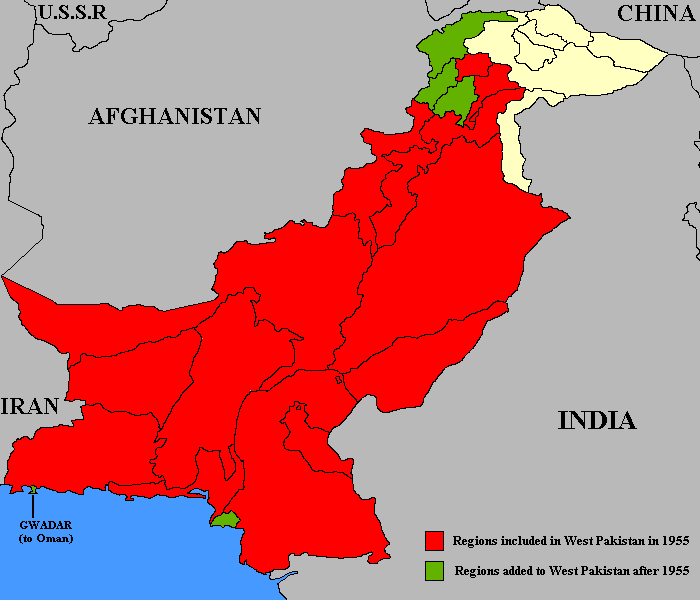

Significance
Immigration from Pakistan has generally reflected the partition of British India, educational advancement, professional employment, economic opportunity, family reunification, skilled migration, international business, and humanitarian migration.
Migration from Pakistan has historically been shaped by the partition of British India, political developments, expanding educational opportunities, and global labor demand. Pakistanis have commonly migrated to the Gulf countries, the United Kingdom, North America, and Europe for employment, higher education, business, and family reunification. Migration to the United States increased significantly after the mid-twentieth century as students, physicians, engineers, scientists, entrepreneurs, and other skilled professionals pursued academic and professional opportunities. Today, Pakistani immigrants have established one of the largest and most diverse South Asian communities in the United States while maintaining strong cultural, linguistic, religious, and family ties with Pakistan.
Pakistani Migration Before Independence
Before independence, the territory of present-day Pakistan formed part of British India under British colonial administration. Migration during the colonial period was influenced by agriculture, trade, military service, government administration, railway construction, higher education, and regional commerce. Residents travelled throughout the Indian subcontinent and the British Empire as farmers, merchants, teachers, students, civil servants, soldiers, and skilled workers. Direct migration to the United States remained relatively limited because political, educational, and commercial connections were centred primarily on the United Kingdom and other British territories. Pakistan became an independent state on August 14, 1947, following the partition of British India, and the United States recognized the new nation soon afterward before establishing diplomatic relations.
Late-Twentieth- and Early-Twenty-First-Century Immigration
Migration increased after independence as educational opportunities, professional careers, and expanding global economic connections encouraged many Pakistanis to seek opportunities abroad. Political developments, economic reforms, and family sponsorship further contributed to migration, while U.S. universities and employers attracted growing numbers of highly skilled professionals. Students, physicians, engineers, scientists, academics, entrepreneurs, information technology specialists, business professionals, and researchers increasingly travelled to the United States for university education, specialized employment, scientific research, investment, or family reunification. In the United States, Pakistani immigrants often rely on family networks, mosques, cultural associations, community organizations, alumni groups, and professional societies for support with housing, employment, education, and community integration while preserving Urdu, English, Punjabi, Sindhi, Pashto, and other regional languages, traditional cuisine, cultural heritage, religious practices, and close relationships with relatives in Pakistan.