Sign In












 Facebook
 X-Twitter
 Instagram
 Linkedin
 Youtube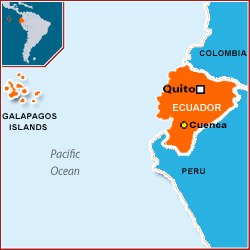

Significance
Ecuadorian immigration to the United States has generally reflected rural poverty, declining agricultural employment, political instability, economic crises, higher wages, education, professional opportunities, family networks, and family reunification.
Ecuadorian migration to the United States remained limited until the middle of the twentieth century. Early arrivals included merchants, sailors, diplomats, students, academics, artists, businesspeople, and professionals travelling for trade, education, or specialised employment. A significant migration network developed during the 1950s and 1960s, particularly among residents of the southern provinces of Azuay and Cañar. The decline of the Panama-hat trade weakened local employment, while commercial connections with New York helped pioneer migrants establish routes to the United States. Migration continued during the 1970s and increased again during the severe economic and political crisis of the late 1990s. Ecuadorian communities became especially visible in New York, New Jersey, Connecticut, Florida, and California.
Ecuadorian Migration Before the Major Immigration Waves
Before the 1950s, direct Ecuadorian immigration to the United States was uncommon. Ecuador separated from Gran Colombia in 1830 and developed as an independent republic, while formal diplomatic relations with the United States were established in 1848. Early connections between the countries were based mainly on diplomacy, maritime trade, agriculture, education, and commerce. Ecuadorians travelling to America were commonly government representatives, merchants, sailors, students, religious workers, intellectuals, or members of internationally connected families. Most people who migrated abroad remained within Latin America because nearby countries were easier and less expensive to reach. However, the export of Panama hats from southern Ecuador to New York created commercial and personal networks that later supported larger migration from Azuay and Cañar.
Late-Twentieth-Century Immigration
Ecuadorian immigration expanded during the late twentieth century as unemployment, declining rural livelihoods, inflation, political instability, and economic uncertainty encouraged families to seek opportunities abroad. The Immigration Reform and Control Act of 1986 allowed more than 16,000 Ecuadorians to obtain lawful permanent residence, enabling many to sponsor relatives later. A second major emigration wave began during the late 1990s, when a severe banking, economic, and political crisis affected the country. Migrants travelled primarily to the United States, Spain, and Italy through employment, education, family sponsorship, and established community networks. New York and New Jersey became major centres of Ecuadorian American life. Immigrants created restaurants, grocery stores, churches, businesses, newspapers, cultural associations, and festivals while preserving Spanish, Indigenous languages, regional food, music, religious customs, and close family connections with Ecuador.