Sign In











 Facebook
 X-Twitter
 Instagram
 Linkedin
 Youtube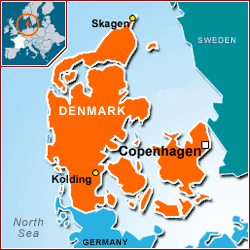

Significance
Danish immigration to the United States has generally reflected religious conversion, agricultural and economic change, demand for land and labour, education, professional opportunities, family reunification, and the search for improved living conditions.
Danish migration to the United States became significant during the nineteenth century. Early arrivals included sailors, merchants, artisans, adventurers, religious dissenters, and farmers. The largest initial movement followed the arrival of American Mormon missionaries in Denmark in 1850, after which thousands of Danish converts migrated to Utah. Later immigrants were more commonly motivated by economic opportunity, population growth, limited farmland, and the higher wages available in America. Danish communities developed in Iowa, Wisconsin, Illinois, Michigan, Minnesota, Nebraska, the Dakotas, Utah, California, and other regions. Immigrants worked in agriculture, dairy farming, manufacturing, construction, shipping, skilled trades, and small businesses while establishing churches, schools, newspapers, fraternal societies, and cultural organisations.
Danish Migration Before the Major Immigration Waves
Before large-scale nineteenth-century immigration, small numbers of Danes reached North America through exploration, colonial commerce, shipping, religious activity, and military service. Danish sailors participated in Dutch expeditions along the Hudson River during the seventeenth century, and people of Danish origin lived in New Amsterdam and other early settlements. Denmark recognised the United States in 1792, and formal diplomatic relations were established in 1801, strengthening political and commercial connections between the countries. From 1800 to 1840, Danish arrivals mainly included seamen, craftspeople, merchants, religious dissenters, and adventurers rather than organised groups of permanent settlers. Because travel was expensive and Denmark experienced less severe famine and land pressure than some neighbouring Scandinavian countries, mass emigration developed later and remained smaller than migration from Norway and Sweden.
Nineteenth- and Twentieth-Century Immigration
Danish immigration expanded after the 1850s through Mormon conversion, economic hardship, and the availability of American farmland. Nearly 20,000 Danish Mormon converts had migrated by the end of the nineteenth century, and Utah became an important centre of Danish settlement. After Denmark lost territory in the war of 1864, economic depression, population growth, and limited land encouraged further emigration. Many families settled in the Midwest under opportunities created by the Homestead Act, while others moved to towns and cities for industrial employment. Immigration slowed after American quota restrictions were introduced during the 1920s and Denmark’s economy improved. Later arrivals increasingly included students, academics, scientists, executives, skilled professionals, and relatives of established immigrants. Danish Americans preserved their heritage through Lutheran churches, newspapers, schools, cooperatives, festivals, food, and organisations such as the Danish Brotherhood.