Sign In










 Facebook
 X-Twitter
 Instagram
 Linkedin
 Youtube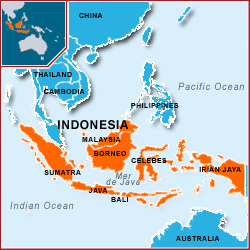

Significance
Immigration from Indonesia has generally reflected Dutch colonial rule, educational opportunities, professional employment, economic development, political change, family reunification, international business, and religious and cultural exchange.
Migration from Indonesia has historically been shaped by its vast archipelago, regional mobility, and colonial ties with the Netherlands. Indonesians commonly migrated within Southeast Asia and to the Netherlands for education, employment, trade, and family connections. Overseas migration expanded after independence as students, healthcare professionals, academics, government officials, entrepreneurs, and skilled workers sought higher education and career opportunities in the United States and other countries. In recent decades, economic growth, globalization, family sponsorship, and professional opportunities have contributed to continued migration to the United States, where Indonesian immigrants have established diverse communities while maintaining strong cultural, linguistic, and family ties with their homeland.
Indonesian Migration Before Independence
Before independence, Indonesia was known as the Dutch East Indies and was administered by the Netherlands. Migration during the colonial period was influenced by agriculture, spice trade, mining, plantation work, maritime commerce, missionary education, government administration, and military service. Residents frequently travelled throughout Southeast Asia as traders, fishermen, labourers, students, civil servants, and members of extended families. Direct migration to the United States remained relatively limited because political, educational, and commercial connections were centred primarily on the Netherlands and other parts of Southeast Asia. Indonesia proclaimed independence on August 17, 1945, and after the Dutch formally recognized Indonesian sovereignty on December 27, 1949, the United States established full diplomatic relations with the new nation.
Late-Twentieth- and Early-Twenty-First-Century Immigration
Migration increased after independence as Indonesians pursued higher education, specialized careers, and improved economic opportunities abroad. Students, physicians, nurses, engineers, scientists, academics, entrepreneurs, information technology specialists, and business professionals increasingly travelled to the United States for university education, specialized employment, research, investment, or family reunification. Academic exchange programs, multinational companies, and expanding trade have continued to strengthen migration in recent decades, while family sponsorship has supported the growth of Indonesian communities across the United States. In the United States, Indonesian immigrants often rely on family networks, mosques, churches, cultural associations, alumni organizations, and professional groups for support with housing, employment, education, and social integration while preserving Bahasa Indonesia, Javanese, Sundanese, and other regional languages, traditional cuisine, music, religious practices, cultural festivals, and close relationships with relatives in Indonesia.