Sign In











 Facebook
 X-Twitter
 Instagram
 Linkedin
 Youtube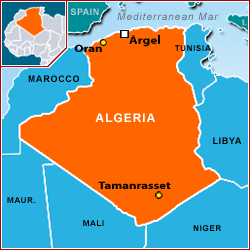

Significance
Algerian immigration to the United States has generally reflected colonial rule, the struggle for independence, educational opportunities, political instability, economic hardship, and the search for professional employment.
Algerian migration to the United States began on a limited scale during the late nineteenth century but remained much smaller than migration to France and other European countries. Movement increased after Algeria gained independence from France in 1962, when students, academics, engineers, doctors, and other professionals travelled to the United States for education and employment. Additional migration occurred during the political violence and economic difficulties of the 1990s. Algerian communities gradually developed in New York, Chicago, Washington, D.C., Boston, Los Angeles, and other metropolitan areas. Family sponsorship, employment visas, university programmes, and the Diversity Visa programme later became important immigration pathways.
Algerian Migration Before Independence
Algerian migration to the United States remained relatively limited while Algeria was governed as a French colony. Most Algerians who left their homeland travelled to France because of colonial connections, labour demand, geographic proximity, and established transportation routes. A small number reached the United States as merchants, sailors, students, labourers, or travellers during the late nineteenth and early twentieth centuries. The Algerian Embassy identifies 1892 as the year of the first recorded Algerian immigrant’s arrival in the United States. Political repression, poverty, military service, and the Algerian War of Independence encouraged migration during the 1950s, although France and neighbouring North African countries remained the principal destinations. Algeria achieved independence in July 1962.
Twentieth-Century Immigration
Algerian immigration increased after independence as the new government sent students and professionals abroad to acquire technical knowledge needed for national development. Many Algerians who entered the United States during the 1970s came for university education, specialised training, research, engineering, medicine, and professional employment. Some returned to Algeria, while others remained and established permanent families and community networks. Migration increased again during the 1990s, when political conflict, unemployment, violence, and economic uncertainty encouraged many Algerians to seek security and opportunity abroad. Expanding American visa opportunities also redirected some migration away from Europe. Algerian immigrants formed cultural associations, businesses, religious institutions, and social networks while preserving Arabic, Tamazight, French, food, music, and family traditions.