Sign In











 Facebook
 X-Twitter
 Instagram
 Linkedin
 Youtube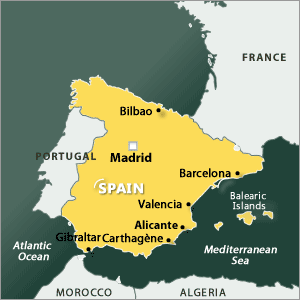

Significance
Spanish immigration to the United States has generally reflected colonial settlement, trade, agricultural and industrial employment, political conflict, economic hardship, education, professional opportunities, and family reunification.
Spanish migration to the lands that became the United States began centuries before the country was established. Explorers, soldiers, missionaries, settlers, merchants, farmers, and administrators founded communities in Florida, the Southwest, California, and other areas under Spanish control. Later immigration came from regions including Galicia, Asturias, the Basque Country, Catalonia, Andalusia, and the Canary Islands. During the late nineteenth and early twentieth centuries, Spanish workers found employment in mining, agriculture, fishing, shipping, cigar manufacturing, construction, and urban industries. Communities developed in Florida, New York, New Jersey, California, Louisiana, West Virginia, and other states, where immigrants established churches, clubs, newspapers, businesses, and mutual-aid societies.
Spanish Migration Before the Major Immigration Waves
Before large modern immigration waves, Spanish movement to North America was closely connected to exploration, colonisation, missionary activity, military expansion, and trade. Spain established settlements across territories that later became parts of the United States, beginning with Saint Augustine in Florida during the sixteenth century. Settlers also arrived from the Canary Islands and other Spanish regions to strengthen colonial communities in Louisiana, Texas, Florida, New Mexico, and California. After much of Spain’s North American territory passed to other governments, migration continued through commerce, shipping, agriculture, and family networks. During the nineteenth century, Spanish immigrants remained fewer than many other European groups, although sailors, merchants, cigar workers, miners, and agricultural labourers formed important local communities.
Late-Nineteenth- and Twentieth-Century Immigration
Spanish immigration increased from the late nineteenth century through the early twentieth century as poverty, rural hardship, industrial employment, military obligations, and political instability encouraged people to leave Spain. Many initially migrated to Cuba, Mexico, Argentina, and other parts of Latin America, while some later continued to the United States. The Spanish Civil War of 1936–1939 and the dictatorship of Francisco Franco produced another movement of political refugees, intellectuals, artists, academics, and professionals. After World War II, improving economic conditions in Spain and expanding opportunities in Western Europe reduced large-scale emigration to America. More recent Spanish migrants have commonly included students, researchers, businesspeople, technology workers, educators, artists, and professionals arriving through employment, education, marriage, and family sponsorship.