Sign In






 Facebook
 X-Twitter
 Instagram
 Linkedin
 Youtube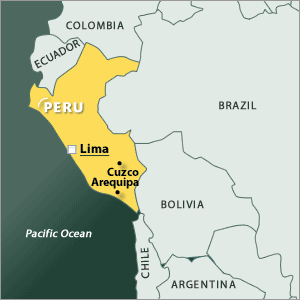
More Information
More Information
Street Soccer in Peru
Street soccer is a popular and vibrant part of football culture in Peru, where children and teenagers regularly gather in neighbourhood streets, school playgrounds, public parks, local courts, and community fields to play informal football matches. These games provide young players with a fun and accessible way to enjoy football, build friendships, and improve their skills.
The creative style of street soccer encourages close ball control, quick passing, skillful dribbling, and intelligent movement. Playing in smaller spaces helps participants develop confidence, creativity, teamwork, and quick decision-making while adapting to different playing conditions.
Street soccer offers an affordable way for communities across Peru to enjoy football without requiring professional facilities. It promotes healthy lifestyles, strengthens neighbourhood connections, and inspires many young players to continue their football journey through schools, clubs, academies, and local competitions.
Street Soccer Culture in Peru
Football is one of the most popular sports in Peru, and street soccer is often where many children first discover their passion for the game. Informal matches organised by friends, schools, and neighbourhood communities create a lively environment where players of different ages and abilities can participate.
Skills Developed Through Street Soccer
Street soccer helps players improve dribbling, first touch, passing accuracy, agility, balance, ball control, and tactical awareness. Regular games also develop creativity, communication, confidence, and the ability to make quick decisions in tight playing situations.
Street Soccer and Community Development
Street soccer brings communities together through football while encouraging teamwork, positive youth participation, and active lifestyles. It also provides aspiring players with valuable experience before progressing to school teams, local football clubs, academies, futsal programmes, or organised youth football competitions.
The PERU in the DMV Metro

The Peruvian diaspora in the Washington, D.C., Maryland, and Virginia (DMV) area is a large, economically active, and culturally prominent Hispanic community. It includes professionals, entrepreneurs, educators, technology workers, contractors, families, and a major culinary workforce. The community is particularly established in Maryland and Northern Virginia suburbs.
Core Community Organizations
-
Embassy of Peru: Located in Washington, D.C., the embassy serves as the main diplomatic and consular hub for Peruvians in the DMV, including outreach and consular services for suburban communities.
-
Peruana Collective: A grassroots professional network connecting Peruvian and Peruvian-American professionals through networking events, mentorship, business activities, and social gatherings.
-
InterNations Peruvians in Washington, D.C.: An online and social network that helps Peruvian expatriates connect, exchange local information, find housing and employment resources, and organize meetups.
Major Cultural & Food Events
-
Taste of Peru DC: A major Peruvian culinary celebration featuring Peruvian restaurants, chefs, cooking demonstrations, music, and traditional dance.
-
Fiestas Patrias: Peruvian Independence Day celebrations in July bring together families and younger generations through food festivals, cultural performances, restaurant events, and nightlife.
-
Festival Peruano Gastronómico de Virginia: A major Northern Virginia gathering featuring Peruvian food, folk dancing, live music, cajón performances, and family activities.
-
Peruvian Restaurant Community: Peruvian cuisine is one of the most visible expressions of the diaspora, with ceviche, pollo a la brasa, anticuchos, lomo saltado, and other specialties widely represented throughout the DMV.
Community Characteristics
-
Large suburban presence: Significant communities are located throughout Montgomery County, Prince George's County, Fairfax County, and Prince William County.
-
Economically diverse: The community includes highly skilled professionals alongside entrepreneurs, contractors, service workers, and restaurant workers.
-
Strong culinary identity: Peruvian restaurants and food festivals play an unusually important role in maintaining and sharing cultural identity.
-
Family-oriented: Community festivals, churches, schools, restaurants, and social organizations provide important gathering spaces.
-
Professional networks: Younger Peruvian-Americans increasingly participate in technology, business, real estate, education, and creative industries.
-
Strong national identity: Fiestas Patrias, Marinera, Andean traditions, Peruvian cuisine, music, and cajón culture remain major cultural connectors.
Significance
Immigration from Peru has generally reflected economic opportunity, political instability, educational advancement, professional employment, family reunification, international business, skilled migration, and humanitarian migration.
Migration from Peru has historically been shaped by economic conditions, political developments, and expanding global educational and professional opportunities. Peruvians have commonly migrated to neighboring South American countries, Spain, Italy, the United States, and other destinations for employment, higher education, business, and family reunification. Migration to the United States increased significantly during the late twentieth century as economic challenges, political violence, and professional opportunities encouraged many Peruvians to settle abroad. Today, Peruvian immigrants have established vibrant communities across the United States while maintaining strong cultural, linguistic, and family ties with their homeland.
Peruvian Migration Before Independence
Before independence, Peru formed the heart of the Spanish Empire's Viceroyalty of Peru, one of the most important colonial administrations in South America. Migration during the colonial period was influenced by agriculture, mining, maritime trade, government administration, missionary activity, and regional commerce. Residents travelled throughout Spanish South America as farmers, merchants, miners, teachers, students, civil servants, and members of extended families. Direct migration to the United States remained relatively limited because political, educational, and commercial connections were centred primarily on Spain and neighboring Spanish territories. Peru declared independence from Spain on July 28, 1821, and achieved full independence following the Battle of Ayacucho in 1824. The United States subsequently recognized Peru and established diplomatic relations.
Late-Twentieth- and Early-Twenty-First-Century Immigration
Migration increased during the late twentieth and early twenty-first centuries as educational opportunities, economic reforms, and expanding professional careers encouraged many Peruvians to seek opportunities abroad. Economic instability, hyperinflation during the 1980s, and violence associated with the Shining Path (Sendero Luminoso) insurgency also contributed to migration through employment, family reunification, and humanitarian pathways. Students, physicians, engineers, scientists, academics, entrepreneurs, information technology specialists, business professionals, and researchers increasingly travelled to the United States for university education, specialized employment, scientific research, investment, or family sponsorship. In the United States, Peruvian immigrants often rely on family networks, churches, cultural associations, community organizations, alumni groups, and professional societies for support with housing, employment, education, and community integration while preserving Spanish, Quechua, Aymara, traditional cuisine, music, cultural heritage, religious practices, and close relationships with relatives in Peru.