








Significance
Colombian immigration to the United States has generally reflected political violence, armed conflict, economic instability, employment opportunities, education, asylum, professional work, and family reunification.
Colombian migration to the United States remained limited until the middle of the twentieth century. Early arrivals mainly included merchants, diplomats, students, academics, artists, businesspeople, and professionals travelling for education, trade, or specialised employment. Significant immigration began during the 1950s and expanded through the 1960s and 1970s. Migration gained further momentum during the 1980s and 1990s as armed conflict, political violence, drug-related insecurity, unemployment, and economic instability encouraged people to leave Colombia. Family sponsorship, professional employment, university education, asylum, and established immigrant networks supported continued settlement. Colombian communities developed especially in Florida, New York, New Jersey, Texas, and other states, where immigrants established businesses, restaurants, churches, newspapers, professional organisations, and cultural associations.
Colombian Migration Before the Major Immigration Waves
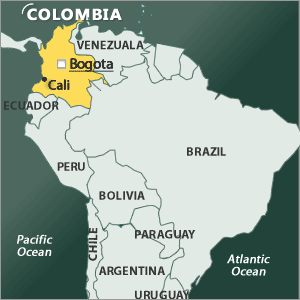
Before the 1950s, direct Colombian immigration to the United States was uncommon. Colombia effectively achieved independence from Spain by 1819, and the United States recognised the new Colombian federation in 1822 and established a diplomatic mission in 1823. Early connections between the countries were based mainly on diplomacy, maritime trade, education, commerce, and travel through the Caribbean ports of Cartagena and Santa Marta. Colombians who reached the United States were commonly government representatives, merchants, sailors, students, religious workers, intellectuals, or members of internationally connected families. Fewer than 7,000 Colombian immigrants reportedly settled in the United States between 1820 and 1950. Most Colombians who moved abroad during this period chose nearby Latin American countries because travelling there was less expensive and family, commercial, and cultural connections were already established.
Late-Twentieth-Century Immigration
Colombian immigration increased considerably during the late twentieth century as prolonged armed conflict, guerrilla warfare, paramilitary violence, drug trafficking, political intimidation, kidnapping, unemployment, and economic uncertainty disrupted communities. Arrivals included professionals, business owners, students, skilled workers, refugees, asylum seekers, and relatives joining established families. The Immigration and Nationality Act of 1965 expanded family- and employment-based immigration opportunities, helping Colombian communities grow in Miami, New York, Orlando, Houston, Tampa, and surrounding areas. Many immigrants maintained close relationships with Colombia through remittances, visits, property ownership, charitable projects, and family communication. Colombian Americans created restaurants, shops, churches, media outlets, cultural festivals, and professional associations while preserving Spanish, regional food, music, dance, religious traditions, and national celebrations. Family reunification later became the leading permanent immigration pathway for Colombians entering the United States.