Sign In









 Facebook
 X-Twitter
 Instagram
 Linkedin
 Youtube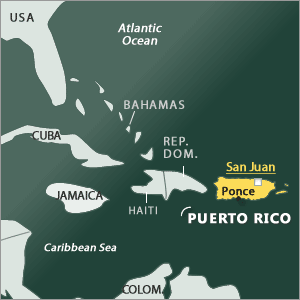

Significance
Immigration from Puerto Rico has generally reflected United States territorial status, economic opportunity, military service, educational advancement, professional employment, family reunification, natural disasters, and internal migration.
Migration from Puerto Rico has played a unique role in the history of the United States because Puerto Ricans are U.S. citizens by birth and therefore move to the mainland as domestic migrants rather than immigrants. Large-scale migration has been shaped by economic modernization, industrialization, military service, educational opportunities, and employment in manufacturing, healthcare, education, government, and business. Economic recessions, hurricanes, and changing labor markets have also encouraged movement between Puerto Rico and the continental United States. Today, people of Puerto Rican origin form one of the largest Hispanic communities in the United States while maintaining strong cultural, linguistic, and family ties with the island.
Puerto Rican Migration Before Commonwealth Status
Before becoming a U.S. territory, Puerto Rico was part of the Spanish Empire for more than four centuries. Migration during the colonial period was influenced by agriculture, sugar production, coffee cultivation, maritime trade, military service, and regional commerce. Residents travelled throughout the Caribbean and the Americas as farmers, merchants, sailors, craftsmen, teachers, and civil servants. Following the Spanish-American War, Spain ceded Puerto Rico to the United States under the Treaty of Paris (1898). The Jones–Shafroth Act of 1917 granted U.S. citizenship to people born in Puerto Rico, allowing them to move freely to the mainland United States. In 1952, Puerto Rico became a self-governing Commonwealth of the United States, while remaining an unincorporated U.S. territory.
Late-Twentieth- and Early-Twenty-First-Century Migration
Migration increased substantially after the Second World War through Operation Bootstrap, which transformed Puerto Rico's economy and encouraged many residents to relocate to the mainland United States for employment, education, and improved living standards. Students, physicians, nurses, engineers, scientists, academics, entrepreneurs, information technology specialists, business professionals, artists, and public servants increasingly moved to the continental United States for university education, specialized employment, research, or family reunification. Economic challenges, the financial crisis, and major natural disasters, including Hurricane Maria in 2017, further accelerated migration to states such as Florida, New York, Pennsylvania, and Texas. Across the United States, Puerto Ricans often rely on family networks, churches, cultural associations, community organizations, alumni groups, and professional societies for support with housing, employment, education, and community integration while preserving Spanish, English, traditional cuisine, music, cultural heritage, religious practices, and close relationships with relatives in Puerto Rico.