






Significance
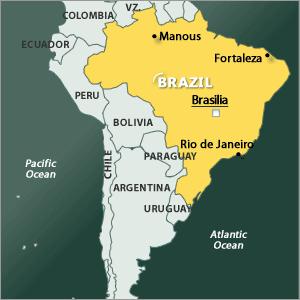
Brazilian immigration to the United States has generally reflected economic crises, inflation, unemployment, education, professional opportunities, family reunification, established migration networks, and the search for higher wages.
Brazilian migration to the United States remained relatively limited until the final decades of the twentieth century. Early arrivals included diplomats, merchants, students, academics, artists, businesspeople, and professionals travelling for education, trade, or specialised employment. Migration increased substantially during the 1980s and 1990s as severe economic instability and hyperinflation encouraged Brazilians to search for work abroad. Many initially planned to remain in the United States temporarily, save money, and then return to Brazil, creating patterns of repeated or circular migration. Brazilian communities gradually developed in Massachusetts, Florida, New York, New Jersey, California, and other states. Churches, businesses, restaurants, cultural associations, and family networks helped newcomers find employment, housing, and social support.
Brazilian Migration Before the Major Immigration Waves
Before the late-twentieth-century migration waves, direct Brazilian immigration to the United States was uncommon. During the Portuguese colonial period, movement between Brazil and North America mainly involved merchants, sailors, diplomats, religious workers, and travellers connected with Atlantic trade. Brazil declared independence from Portugal in 1822, and the United States formally recognised the new empire and established diplomatic relations in 1824. These relations supported greater commercial, political, and educational contact, but they did not immediately produce large immigrant communities. Throughout much of the nineteenth and early twentieth centuries, Brazil itself was an important destination for European, Middle Eastern, and Asian immigrants. Brazilians who travelled to the United States were usually students, government representatives, professionals, businesspeople, or members of families with international connections.
Late-Twentieth-Century Immigration
Brazilian immigration increased rapidly during the 1980s and 1990s as economic stagnation, unemployment, and hyperinflation weakened living conditions and employment prospects. About 40,000 Brazilian immigrants lived in the United States in 1980; the number doubled by 1990 and rose to more than 200,000 by the beginning of the twenty-first century. Many migrants entered through tourist, student, family-sponsored, or employment-based visas, while some remained after temporary visas expired. Established communities and church networks encouraged further migration, particularly from Minas Gerais and other southeastern Brazilian states. Greater Boston became a major centre of Brazilian settlement, while significant communities also formed around Miami, New York, Newark, Los Angeles, and Atlanta. Brazilian immigrants established businesses, restaurants, newspapers, churches, festivals, and cultural organisations while preserving Portuguese, music, food, religious traditions, and close relationships with relatives in Brazil.