








Significance
Canadian immigration to the United States has generally reflected a shared border, colonial settlement, agricultural and industrial employment, political conflict, family connections, education, professional opportunities, and economic integration.
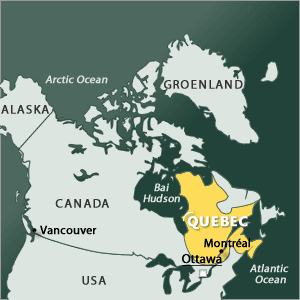
Canadian migration to the United States has occurred continuously since the colonial period and has involved French-speaking, English-speaking, Indigenous, Acadian, and other communities. Movement was often temporary or circular because the long shared border allowed workers and families to travel relatively easily between the two countries. During the nineteenth and early twentieth centuries, large numbers of French Canadians left Quebec for textile and manufacturing employment in New England, while other Canadians settled in the Great Lakes, Midwest, Pacific Northwest, and northern states. Later migrants included students, healthcare workers, engineers, academics, entertainers, businesspeople, and other professionals. Canadian immigrants created churches, neighbourhoods, newspapers, cultural associations, and family networks while maintaining close social and economic relationships with Canada.
Canadian Migration Before Confederation
Before Canadian Confederation in 1867, movement into the territory that became the United States was shaped by French and British colonial settlement, warfare, trade, religion, and changing political borders. French settlers, merchants, missionaries, soldiers, and farmers travelled throughout New France, the Great Lakes, and the Mississippi Valley. Acadians expelled from eastern Canada during the eighteenth century eventually settled in Louisiana and contributed to the development of Cajun culture. After the American Revolution, some Loyalists moved north into British territory, while other residents of British North America travelled south for land, trade, maritime employment, or family reasons. Because modern Canada did not yet exist, migrants were commonly identified as French Canadians, Acadians, British subjects, or residents of individual colonies rather than simply as Canadians.
Nineteenth- and Twentieth-Century Migration
Canadian migration increased during the second half of the nineteenth century as industrial growth in the United States created demand for factory, mining, railway, forestry, construction, and agricultural workers. Textile companies recruited French Canadians from Quebec, and communities developed across Massachusetts, Rhode Island, Maine, New Hampshire, and other New England states. Migrants established Catholic parishes, French-language newspapers, mutual-aid societies, schools, and neighbourhoods that helped preserve their language and identity. English-speaking Canadians also moved to Michigan, Minnesota, New York, Washington, California, and other regions for farming, trade, and industrial work. During the twentieth century, improved economic conditions in Canada reduced large-scale emigration, but cross-border movement continued through education, professional employment, marriage, entertainment, business, and family reunification. Canada and the United States established formal diplomatic relations in 1927.