Sign In








 Facebook
 X-Twitter
 Instagram
 Linkedin
 Youtube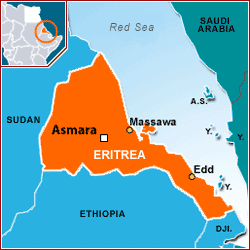

Significance
Eritrean immigration to the United States has generally reflected colonial rule, the struggle for independence, political repression, regional warfare, compulsory national service, refugee displacement, education, employment, and family reunification.
Eritrean migration has historically focused on Sudan, Ethiopia, the Middle East, and Europe rather than directly on the United States. Movement increased during Eritrea’s prolonged struggle for independence from Ethiopia, when warfare and insecurity displaced hundreds of thousands of residents. Early arrivals in America primarily included students, diplomats, academics, religious workers, professionals, political exiles, and refugees. Immigration expanded after American reforms removed restrictive national-origin quotas and humanitarian programmes provided protection for people displaced by conflict. Eritrean immigrants established churches, mosques, businesses, cultural associations, and family networks while preserving Tigrinya, Tigre, Arabic, food, music, religious traditions, and close connections with relatives abroad.
Eritrean Migration Before Independence
Before independence, migration was shaped by Italian colonial rule, British administration, federation with Ethiopia, annexation, and armed conflict. Eritrea became an Italian colony during the late nineteenth century and came under British administration after Italy’s defeat in World War II. In 1952, the United Nations arranged for Eritrea to become an autonomous territory federated with Ethiopia. Ethiopia ended the federation and annexed Eritrea in 1962, while an independence movement conducted a political and military struggle that lasted almost thirty years. Warfare, military recruitment, economic disruption, and political persecution forced many Eritreans into Sudan and other neighbouring countries. Direct settlement in the United States remained comparatively limited, although students, professionals, religious figures, and political exiles gradually developed migration networks.
Late-Twentieth- and Early-Twenty-First-Century Immigration
Eritrean migration continued after the independence struggle ended in 1991 and the country achieved internationally recognised independence in 1993. The United States recognised Eritrea in April 1993 and established diplomatic relations that June. Although many refugees initially returned home, the 1998–2000 border war with Ethiopia produced renewed displacement. Later emigration was influenced by economic hardship, political restrictions, detention, and lengthy national-service obligations. Eritreans reached the United States through refugee resettlement, asylum, university education, professional employment, family sponsorship, and the Diversity Visa programme. UNHCR also arranged the American resettlement of vulnerable Eritrean groups, including Kunama refugees living in Ethiopia. Community and religious organisations helped newcomers obtain housing, employment, education, healthcare, and language support while maintaining Eritrean cultural identity.